
MSTFA / Industries
MSTFA Industries
Navigate
Home Systems Capabilities Company Investors
More
Updates Talent Contact
Systems/Neura

Continuous neural observation, behind the ear.

Neura is a discreet mastoid-worn patch fusing two-channel EEG with photoplethysmography, electrodermal activity, and skin temperature — modeling physiological risk continuously instead of waiting for symptoms.

5
Sensing modalities
256 Hz
EEG sampling rate
<18 g
Device mass · 8+ hr wear
30 s
Risk model update interval
The Problem

Neurological events announce themselves early. Almost nothing is listening.

Migraine prodrome, autonomic stress load, and related neurological states produce measurable physiological signatures — elevated high-beta EEG activity, declining heart-rate variability, electrodermal spikes, peripheral temperature shifts — in the minutes to hours before onset.

Capturing those signatures outside a laboratory requires an instrument people will actually wear. Neura's mastoid placement reaches usable EEG positions (TP9/TP10) while remaining nearly invisible in daily life.
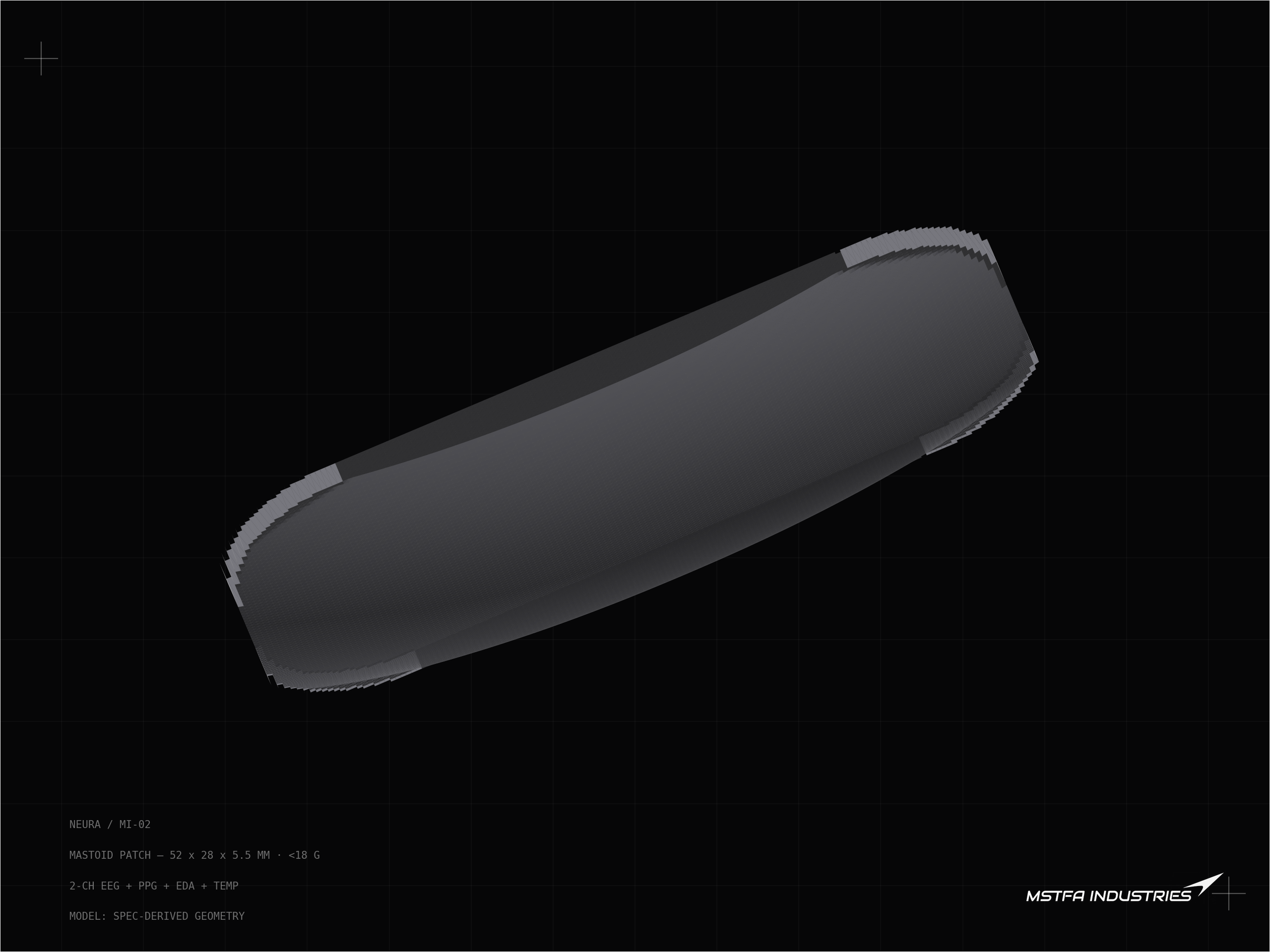
Neura — engineering render
Instrument

Specification.

EEGTwo channels at TP9/TP10 (mastoid), 256 Hz, ADS1299 24-bit front end — alpha, beta, theta, and high-beta band power
PPGOptical, 64 Hz — heart rate and heart-rate variability (RMSSD, SDNN, pNN50, LF/HF)
EDAHydrogel contacts — tonic skin conductance level and phasic responses (sympathetic arousal)
TemperatureThermistor, 1 Hz — peripheral vasoconstriction precursor
IMUThree-axis — motion-artifact detection and epoch gating
Enclosure52 × 28 × 5.5 mm, under 18 g, medical-grade silicone/TPU, IPX4, magnetic pogo charging
Pipeline

Two-stage inference, calibrated per person.

01

Feature extraction

A 12-dimension vector computed every 30 seconds on-device: band powers, HRV metrics, electrodermal events, temperature deviation — with motion-gated artifact rejection.

02

Real-time scoring

A gradient-boosted classifier scores structured features in real time; a sequence model evaluates longitudinal windows.

03

Personal calibration

A seven-day calibration period establishes individual baselines before adaptive thresholds activate.

04

Evidence anchoring

Training draws on public reference datasets (PhysioNet cognitive-state corpora, motion-artifact datasets), with biomarker thresholds anchored in published quantitative EEG literature — including QEEG analysis of 619 migraine patients identifying high-beta Z-score elevation as a significant biomarker.

Development Status

Where the program stands.

CompleteSensing architecture, enclosure design, feature pipeline definition, biomarker literature base.
In progressHardware design build-out on the shared ADS1299/ESP32-S3 platform.
Clinical advisoryWritten endorsement of the minimal-channel EEG methodology from Dr. Ronald J. Swatzyna (Houston Neuroscience Brain Center), May 2026.
PathwayFDA 510(k); pre-clinical.

All systems     Discuss the program

All device programs are pre-clinical prototype and concept work. No MSTFA instrument is FDA cleared, CE marked, or available for clinical use.